Agglomeration economies
Agglomeration economies refer to the benefits that firms and industries gain from locating close to one another within a particular geographic area. These benefits arise from various sources, including: labor pool, knowledge spillovers, specialized suppliers and services, infrastructure and amenities, access to markets and risk sharing and flexibility.
Agglomeration economies are often cited as drivers of urbanization and regional development, as they encourage the clustering of economic activities in specific areas, leading to increased productivity, innovation, and competitiveness. However, challenges such as congestion, increased competition for resources, and rising living costs may also arise in agglomerated regions. Understanding and leveraging agglomeration economies are crucial for policymakers, urban planners, and businesses aiming to foster sustainable economic growth and development.
In order to test agglomeration economies, there are some test or procedures that gives you and idea of a concentrated behavior. One of them focuses specifically on assessing the spatial concentration of economic activities, such as industry, employment or production, and on identifying patterns of agglomeration or dispersion. On the other hand, there is an index that is used to evaluate the spatial distribution of events or characteristics in a given area and it provides information about how events or features are distributed within a region and whether there are significant spatial clustering patterns.
Escenaries
Below I show you two examples made with information from Encuesta Nacional de Hogares (2016), specifically with the number of companies registered in that year. This data contains georeferenced companies by geographic areas.
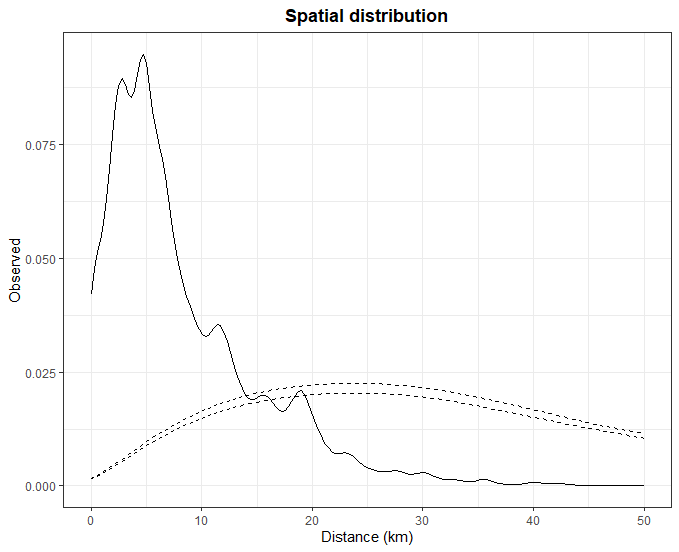
The first graph shows you the agglomeration distance and its behavior through a specific territory. For more information regarding the commands used, please feel free to email me on p.valcarcel@uniandes.edu.co.
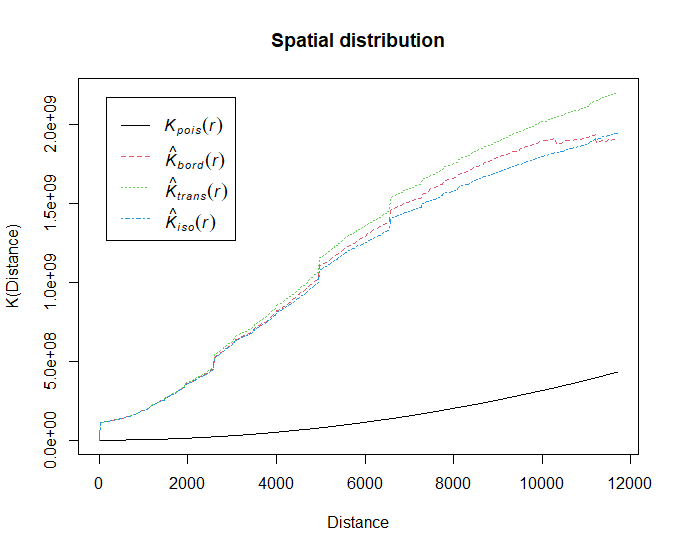
The second graph shows you the agglomeration points based on a certain space. The function compares the value observed at a certain distance with the value expected at that same distance.